The problem
A fluent LLM response is not automatically a useful teaching dialogue. Classroom content must retain instructional context, follow an appropriate teaching style, and remain relevant when an expert’s approach is transferred to a new topic.
How ELF works
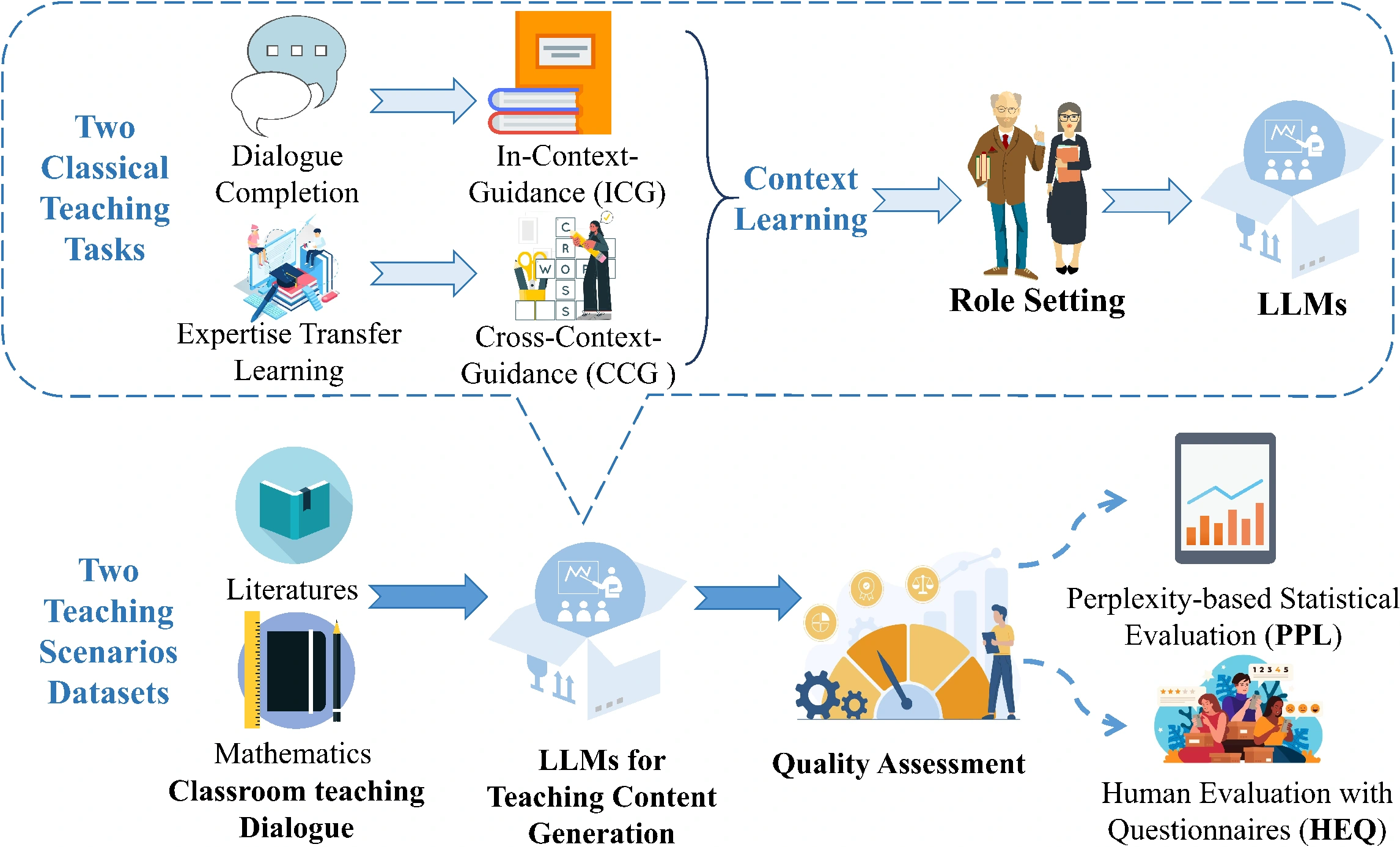
- Context learning supplies selected teaching examples to guide the model, preserving the structure and content of teacher-student interaction.
- Role setting specifies the instructional role and style expected from the generated response.
- Dialogue completion extends an existing teaching exchange, while expertise transfer applies instructional knowledge and style to a different teaching context.
These tasks are evaluated within one framework, connecting content generation with explicit assessment of its teaching quality.
Two teaching tasks, one generation framework
Dialogue completion with in-context guidance
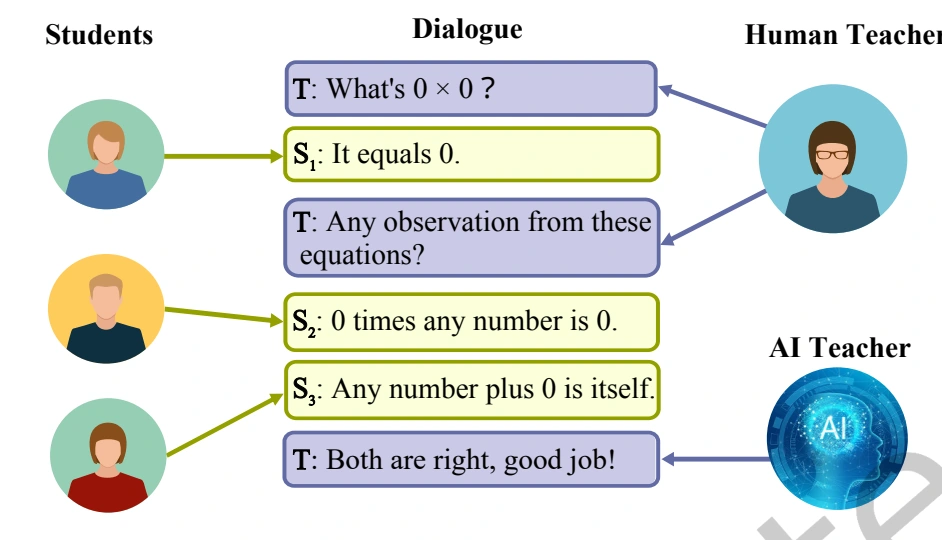
The dialogue-completion task removes a middle fragment of a classroom exchange and asks the model to restore it using the surrounding dialogue. This requires the generated fragment to connect to both the earlier and later discussion, rather than simply producing an isolated explanation.
ELF’s In-Context Guidance (ICG) first asks the model to summarize the lesson and understand its instructional design. Dynamic Role Setting (DyRS) then assigns an appropriate teaching role. A task-specific instruction identifies the missing fragment and directs generation. The sequence separates understanding the lesson from producing its continuation.
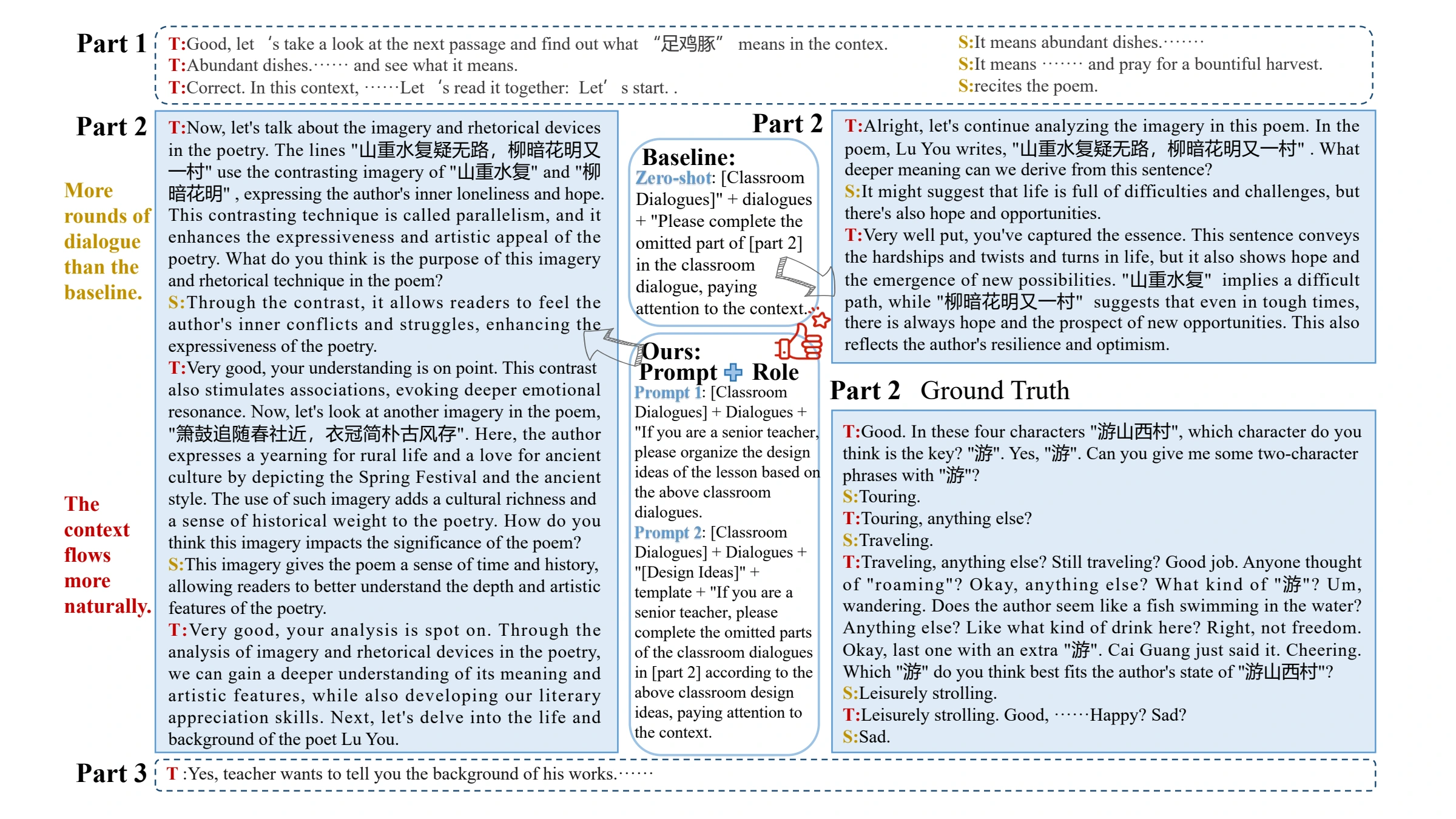
The example compares the initial context, a zero-shot completion, ELF’s completion, and the reference fragment. The surrounding dialogue constrains what belongs in the missing section; the generated content needs to maintain the lesson’s flow and teacher-student interaction.
Expertise transfer with cross-context guidance
Expertise transfer uses high-quality classroom material to guide a lesson on a different topic. Cross-Context Guidance (CCG) supplies expert instructional examples, while role setting asks the model to adopt the relevant teaching perspective. The intended transfer concerns lesson organization, classroom interaction, teaching style, and time management, rather than copying the original subject matter.
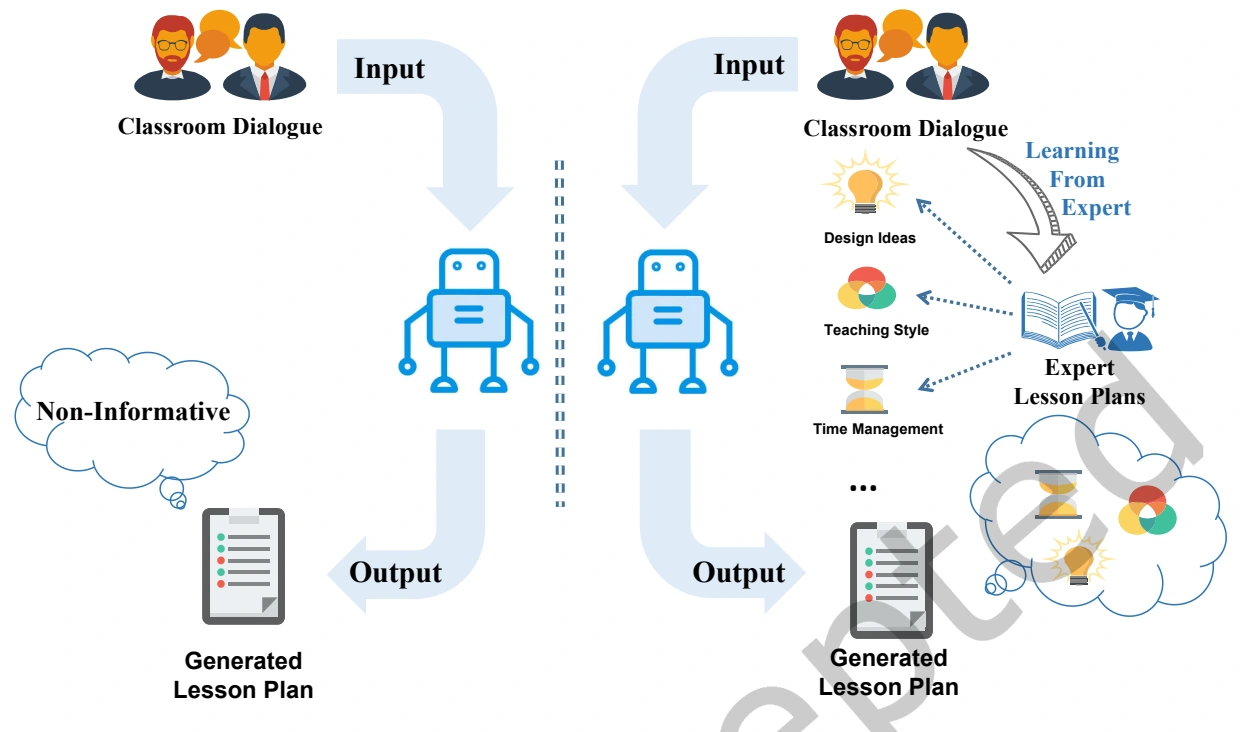
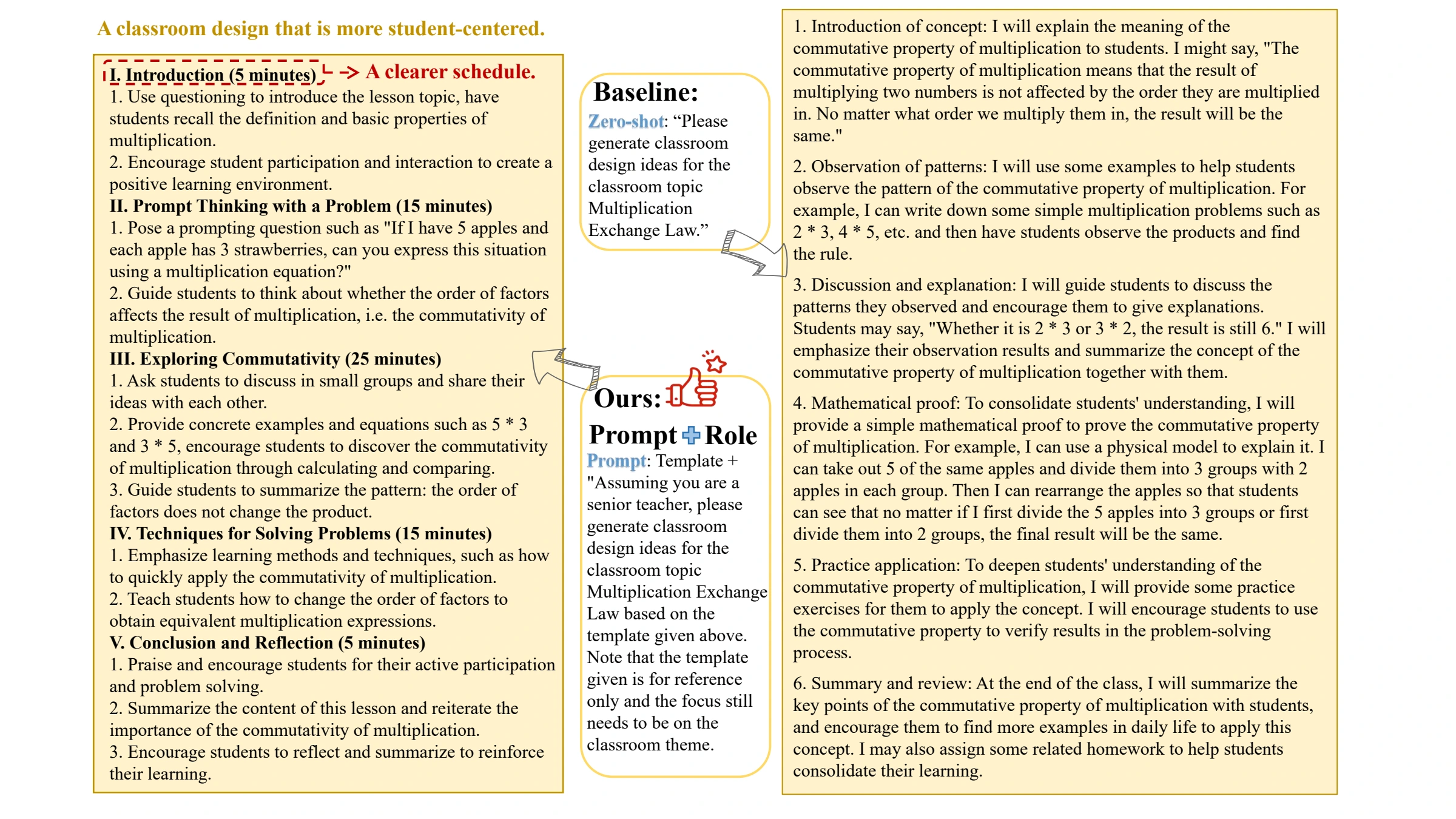
The lesson-plan example contrasts a zero-shot response with generation guided by an expert teaching template. It makes the difference between a generic sequence of teacher actions and a more structured classroom plan concrete.
Datasets and evaluation protocol
The study collects 20 literature courses and 20 mathematics courses, each approximately 40 minutes long, from recorded classroom teaching. Literature includes poetry, prose, novels, and related topics; mathematics includes algebra, geometry, probability, and statistics. Dialogue is transcribed into teacher-student turns.
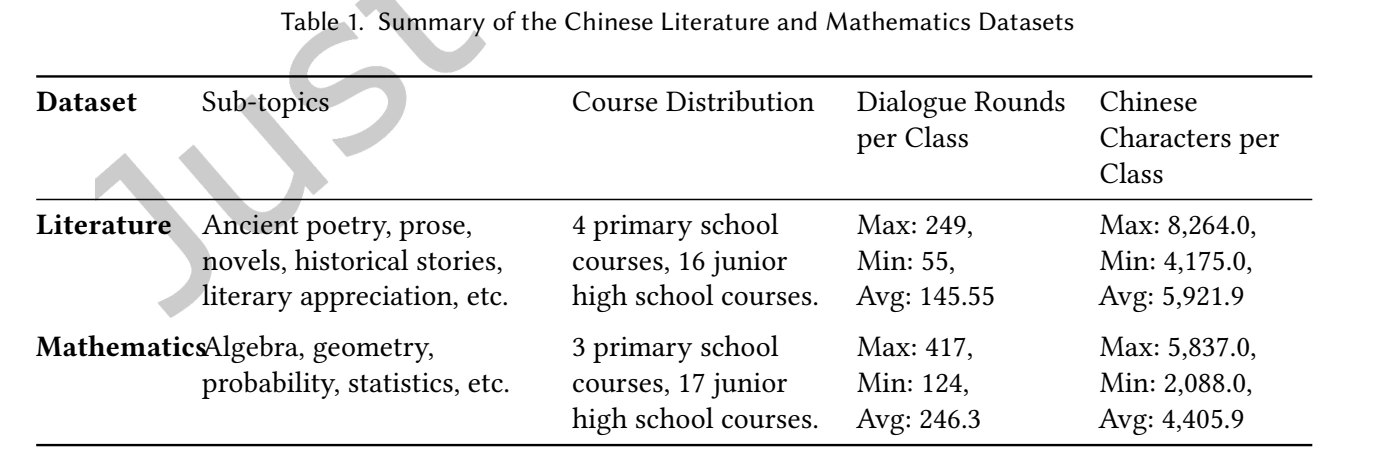
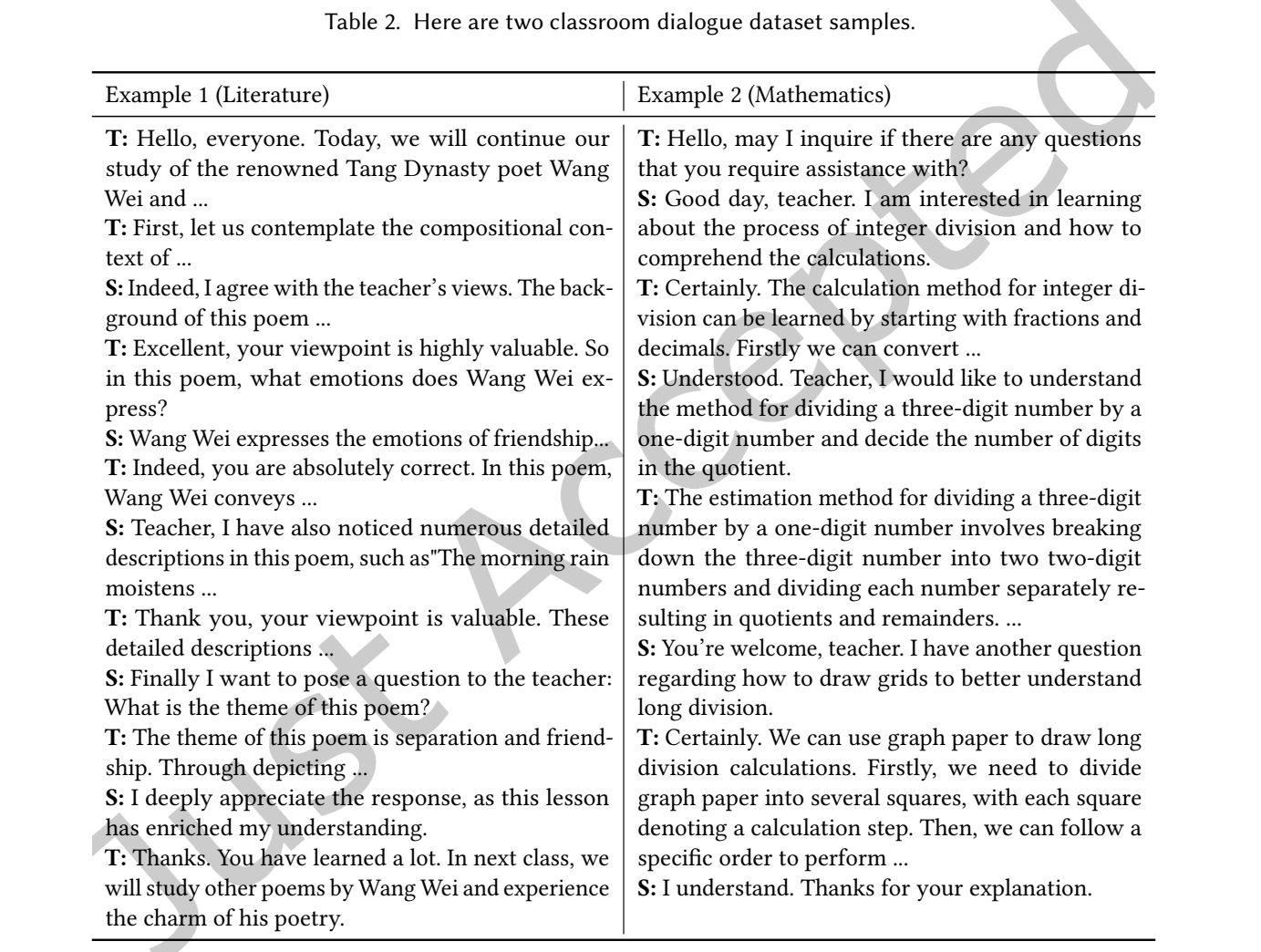
The dataset examples above are presented in English translation in the manuscript. The underlying classroom-dialogue data are Chinese.
Perplexity (PPL, lower is better) uses a GPT-2-based language model to measure how predictable generated text is. Human Evaluation with Questionnaires (HEQ, higher is better) assesses language smoothness, clarity, context consistency, factual accuracy, teaching strategies, and instructional organization. Dialogue completion also uses BERTScore, ROUGE-L, and BLEU-4 against reference text.
Generation quality in the two scenarios
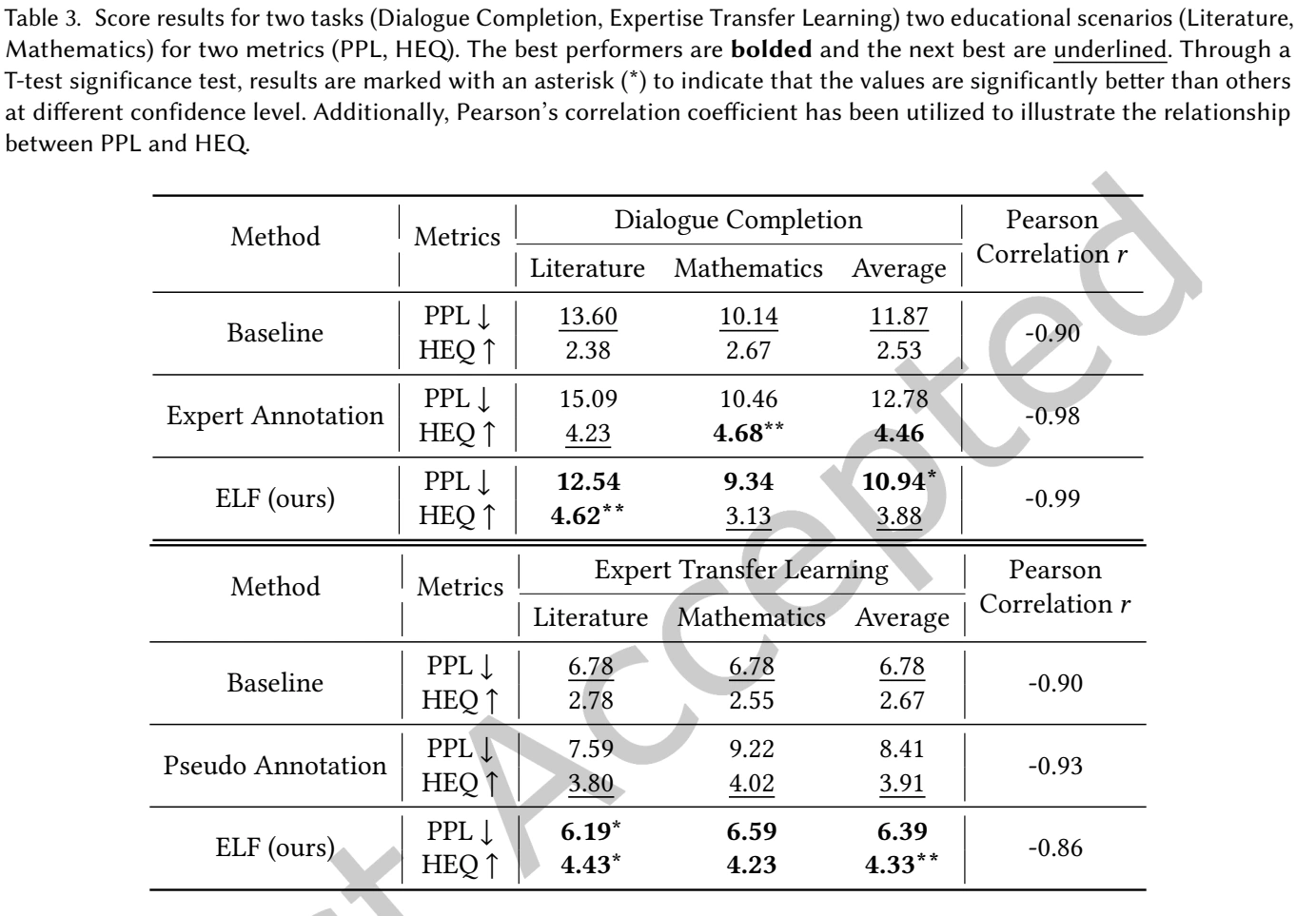
For dialogue completion, ELF’s average PPL is 10.94, versus 11.87 for the baseline; average HEQ is 3.88, versus 2.53. Expert annotation has average HEQ 4.46, so the human-rating comparison does not claim that generated dialogue exceeds expert teaching across the board.
For expertise transfer, average PPL changes from 6.78 to 6.39, and average HEQ from 2.67 to 4.33. Table 3 also retains subject-level scores, statistical significance markings, and the reported relationship between PPL and HEQ.
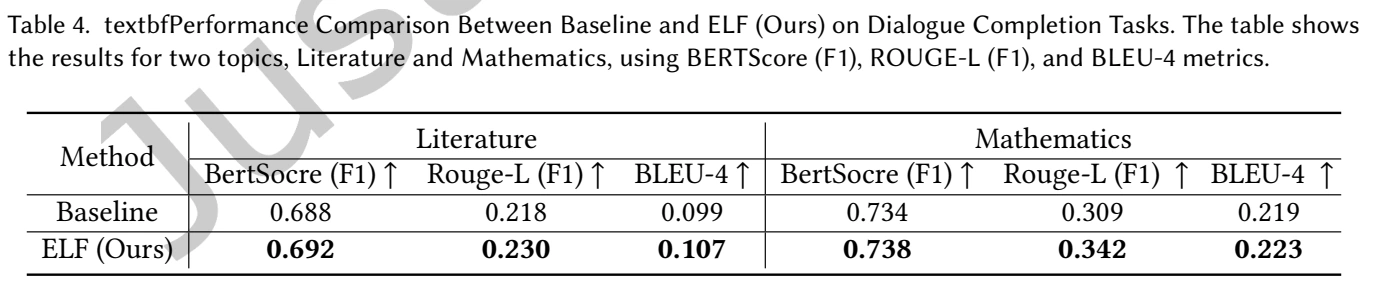
Reference-based dialogue metrics improve for both subjects. For example, mathematics ROUGE-L increases from 0.309 to 0.342, and literature BLEU-4 from 0.099 to 0.107. These metrics complement the human questionnaire: overlap with a reference and instructional quality measure different aspects of the output.
Separating context guidance from role setting
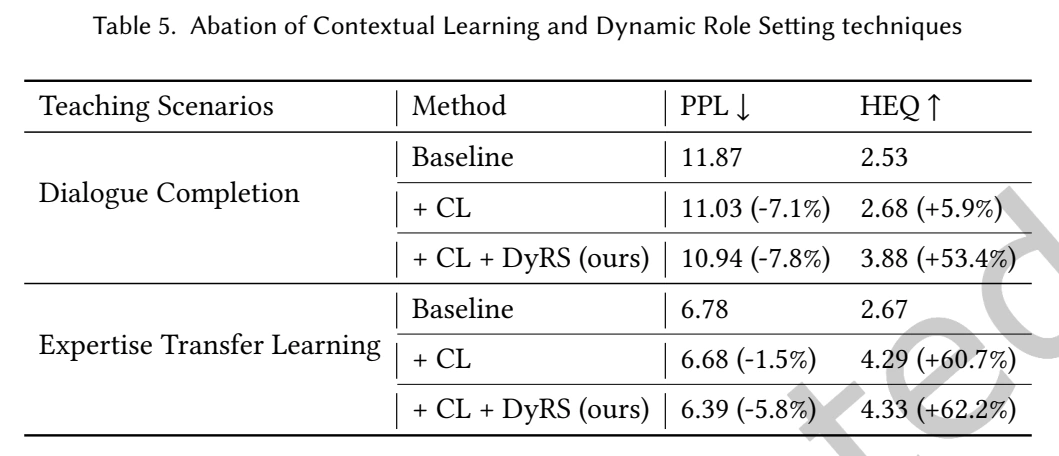
In dialogue completion, context learning alone changes PPL from 11.87 to 11.03 and HEQ from 2.53 to 2.68. Adding DyRS yields 10.94 PPL and 3.88 HEQ. In expertise transfer, context learning provides most of the HEQ increase (2.67 to 4.29), with the full configuration reaching 4.33. The ablation shows that the two techniques affect the tasks differently.
Related reading
Our earlier perspective, Towards Applying Powerful Large AI Models in Classroom Teaching: Opportunities, Challenges and Prospects (arXiv, 2023), discusses the broader teaching scenarios behind this line of research. The published ELF article is linked above.